MUST SEE ON THE PROMENADE:
The Teatro Margherita (foto) is one of the most characteristic and symbolic monuments of Bari. Visible in the distance both from the seafront and along Corso Vittorio Emanuele II, the theater rests its foundations directly on the sea of Bari. Its history is very fascinating: it begins in 1910, coinciding with the birth of the Petruzzelli Theater, with an entirely wooden structure which, however, just a year later, was destroyed by a fire whose causes still remain unknown today. The reconstruction took place in 1914, this time in reinforced concrete, but with the foundations still in the sea, thus making history not only for being the first reinforced concrete structure built in Bari but above all for being the only building in all of Europe built on piles . Even the Margherita theater, like other historical monuments in Bari, was seriously damaged by bombing and by the events of the world war; however the structure was refurbished and in a short time it was converted into the "Cinema Margherita". However, after several years of film screening, also thanks to the crisis in cinema, the theater closed and was left to its own devices. Only a recovery and restoration plan for the theatre, launched towards the 2000s, has restored the rightful importance to this important monument; today the Margherita theater has started to live again, no longer as a theater but as a cultural container dedicated to exhibitions of national and international importance.
The Molo San Nicola (foto), which houses the picturesque fish market ("nderr alla lanze") where it is possible to watch the characteristic beating of the octopus, buy excellent fresh fish and get in touch with the sincerity and cordiality of the local fishermen. The pier has become an important meeting point for fishermen, tourists and young people of the city attracted and enchanted by the beautiful view of Bari, its majestic buildings, the wonderful promenade and the freshly caught delicacies, also thanks to the presence of the popular pub "Il Chiringuito" where you can experience the thrill of drinking a beer (strictly a Peroni) right by the sea.
Continuing south you will find some of the most palaces in Bari: Teatro Kursaal Santa Lucia (foto) in late Liberty style. Inserted in a characteristic green setting beyond which it is possible to see the sea, the Kursaal Santa Lucia hosts a double function of cinema-theater and apartments on the upper floors. Outside, the large openings in the central area reveal the splendor of the Giuseppina room. The latter is embellished with high reliefs and frescoes by the Turin brothers Mario and Guido Prayer, well-known decorator artists of the time.
The Palazzo della Provincia (foto) is an eclectic building that hides sumptuous halls and impressive sculptures inside. It looks like an irregular quadrilateral, in which Trani stone and red bricks alternate. At the center of the base there is a marble portico, surmounted by a beautiful coffered ceiling. The most characteristic element is undoubtedly the Clock Tower (foto), 62 meters high and divided into five levels, from whose portico you can enjoy a breathtaking view of the city and the sea. Every room in the building is cared for down to the smallest detail, from the marble to the ceiling decorations, to the cabinet-making work. In short, while winking at the need for scenographic monumentality wanted by the fascist regime for the new city maritime front, it does not conform to that "littorio" language that characterized most of the interventions of the time. Inside the building is the Pinacoteca Metropolitana di Bari, which collects paintings by Apulian, Venetian, Tuscan and Neapolitan artists, from the Middle Ages to the Contemporary Age.
The historic Grande Albergo delle Nazioni (foto), the iconic building set on the sea, in addition to being a hotel, was also a film set, Allied headquarters and theatre: all elements that allowed it to become part of the most famous buildings in the city . Designed in 1932 by the architect Alberto Calza Bini, it was inaugurated on 31 August 1935, coinciding with the opening of the VI edition of the Fiera del Levante. The creator of the interior furnishings was the Bulgarian futurist artist Nicolaj Djulgherov, who conceived them in the name of elegance, with exposed marble and luxurious rooms for conferences and receptions. White in colour, it has a semi-cylindrical shape, in stark contrast to the axial symmetry of the other waterfront buildings.
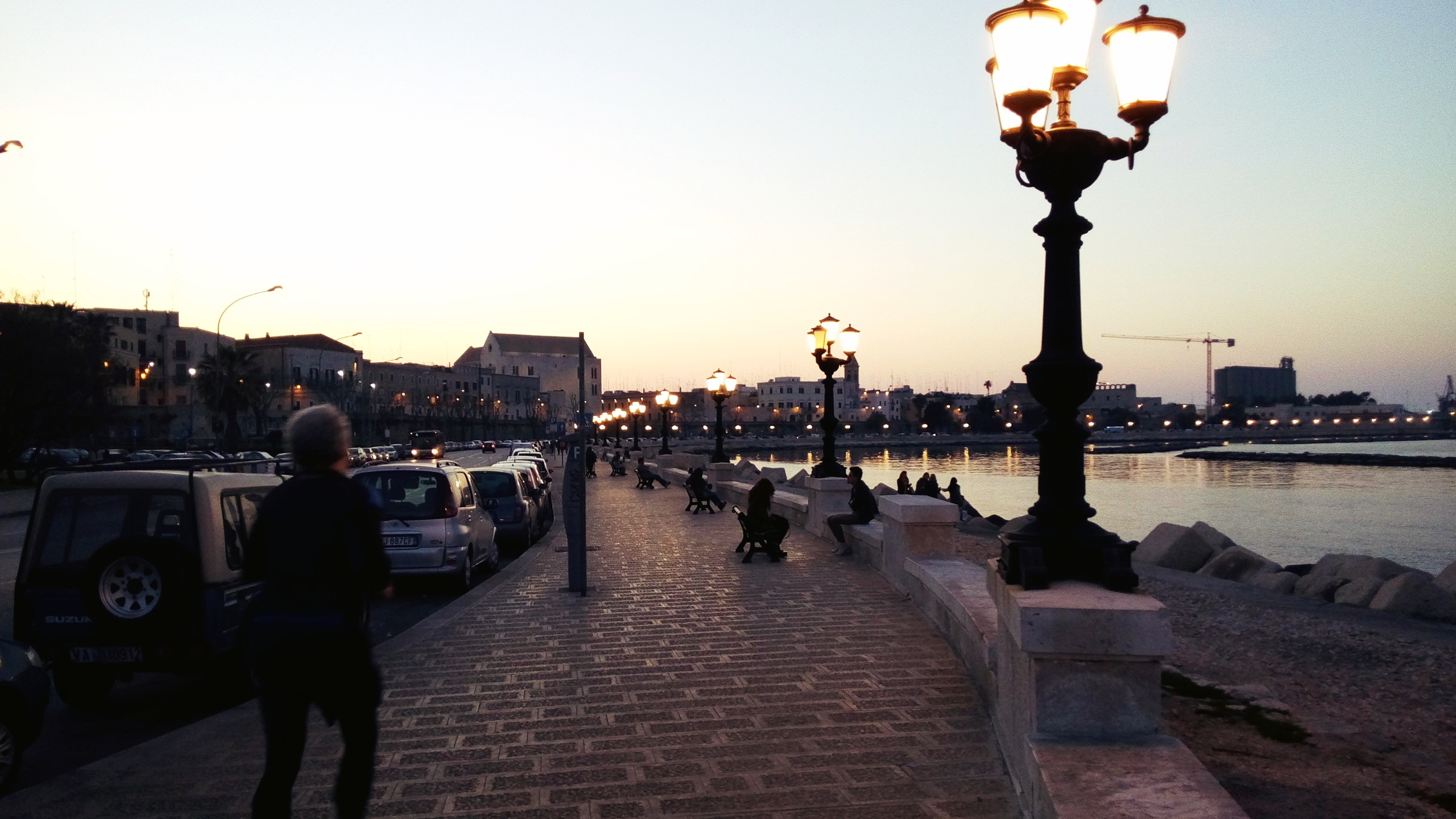
Pane e Pomodoro (foto) is Bari's public beach, open to anyone who wants to lie down in the sun or simply swim after a walk along the seafront. Yes, because there is everything a person needs for his enjoyment; there are sea, sand, rocks, gardens, wooden platforms, pebble and gravel areas. In addition there are also services, in fact there are bars, toilets, showers, lifeguards and lifeguards and it is a stone's throw from the city center of Bari. Pane e Pomodoro is in fact at the end of its walk and, especially at sunset, you can enjoy a beautiful panorama where you can admire the Teatro Margherita, the Basilica of San Nicola, the very high bell tower of the Cathedral of San Sabino in the distance as well as Bari Vecchia with its walls.